Power Systems Control
Power systems are undergoing a fundamental transition to achieve net-zero carbon emissions. Major trends include the widespread integration of distributed renewable generation, the electrification of heating and transportation, and the integration of consumer-level ICT infrastructure allowing granular sensing and coordination. These trends create an opportunity to intelligently coordinate new distributed sources of flexibility, including electric vehicles, heat-pumps and batteries, to improve system efficiency, reduce renewable curtailment and reduce the need for costly infrastructure upgrades.
However, there are also major new challenges. Where grid control previously relied on a few hundred large power plants, generation and flexibility is now being delivered by millions of distributed grid-edge devices. These devices are embedded in local distribution networks with extensive topologies and nonlinear characteristics. System uncertainty is also growing, due to the weather dependence of renewable sources and the behaviour dependence of flexible loads.
To address this challenge, we are developing multi-agent coordination strategies to unlock the computational bottlenecks which limit the value of grid-edge flexibility. Guided by a firm grounding in the power grid problem domain, we collaborate across disciplines to make use of the latest advances from the control, operations research and machine learning communities. The long-term vision is to support the widespread integration of grid-edge flexibility across local and national electricity market operation, helping to lower energy bills and accelerate the net-zero transition.
Key Research Streams
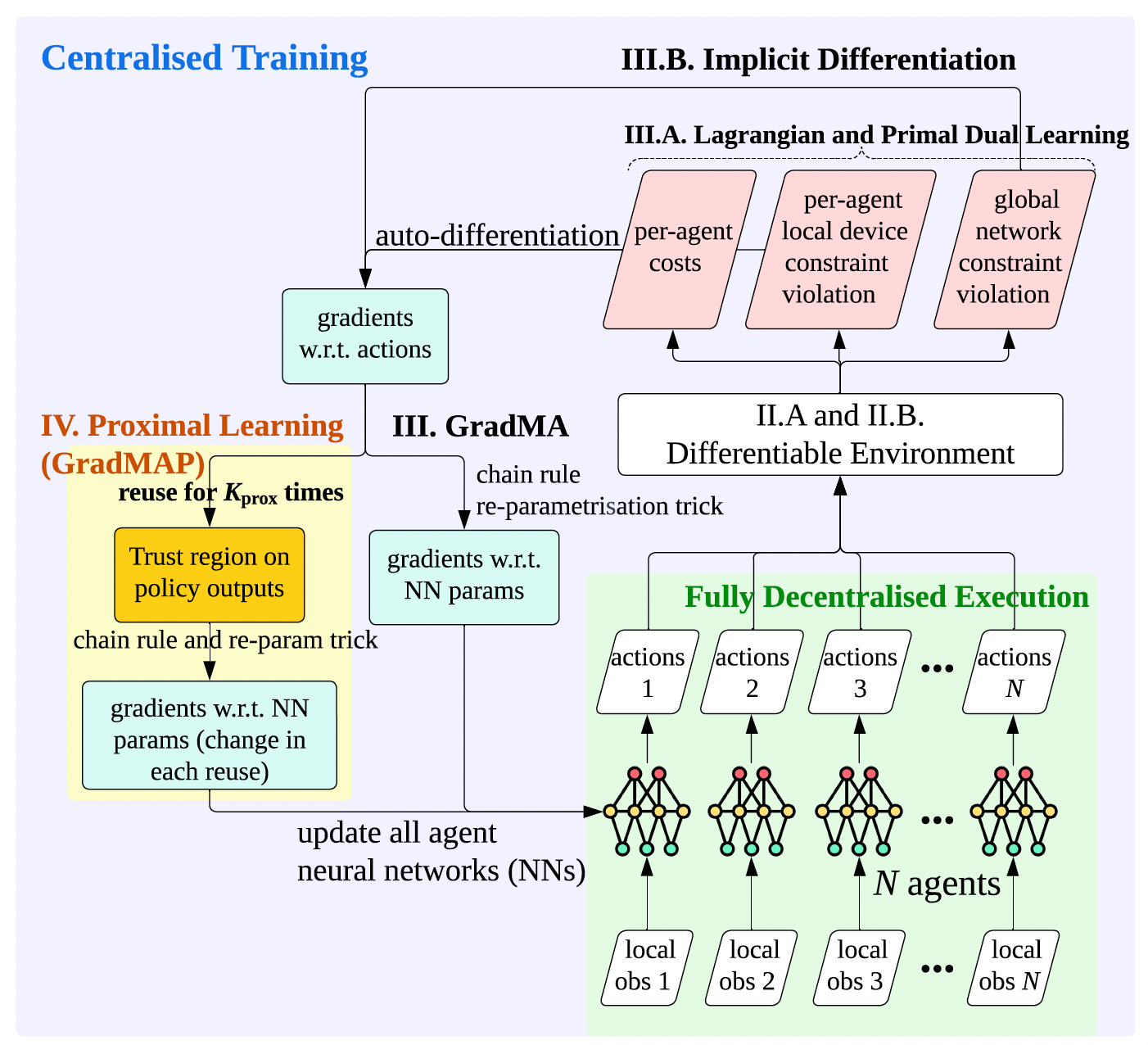
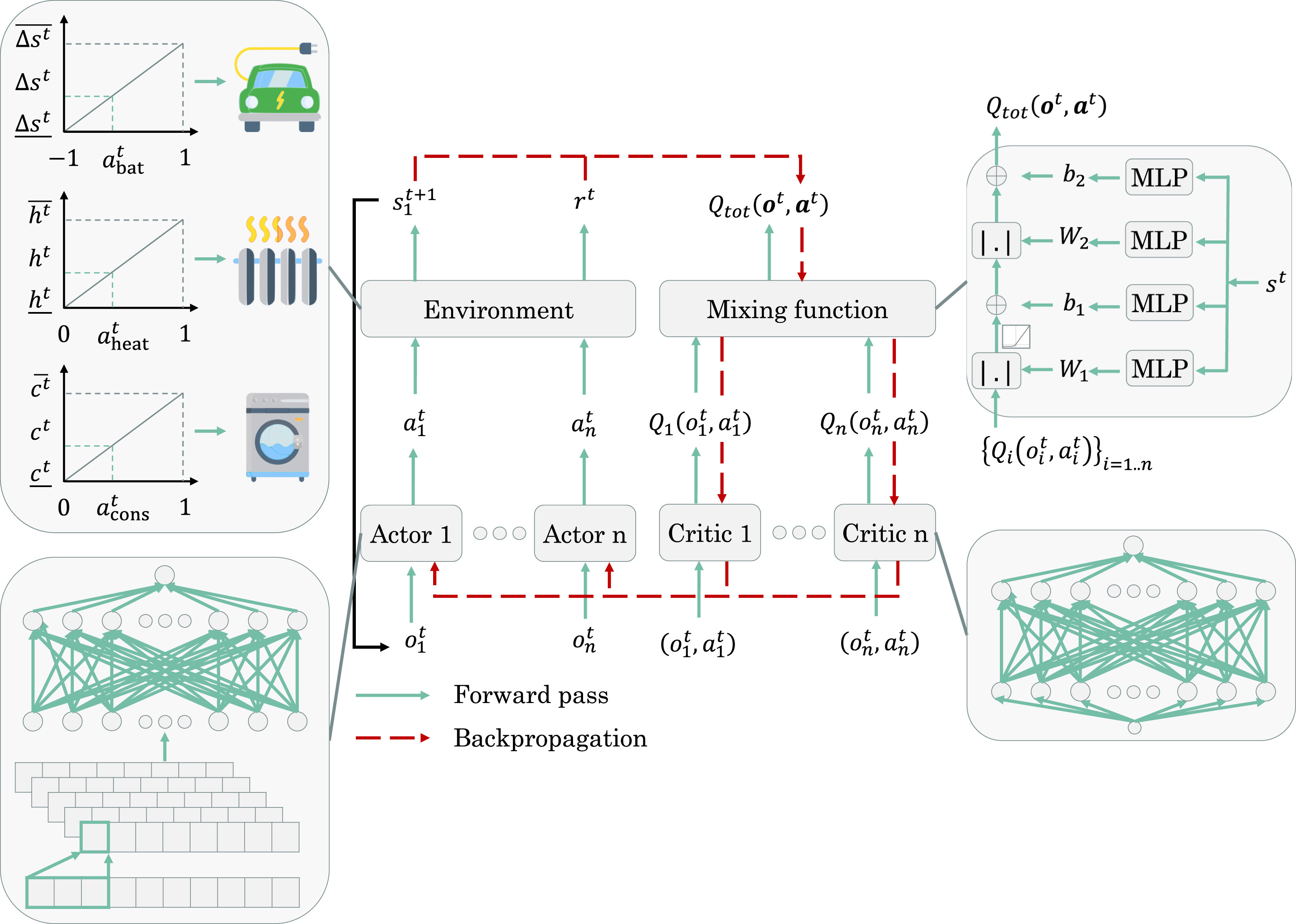
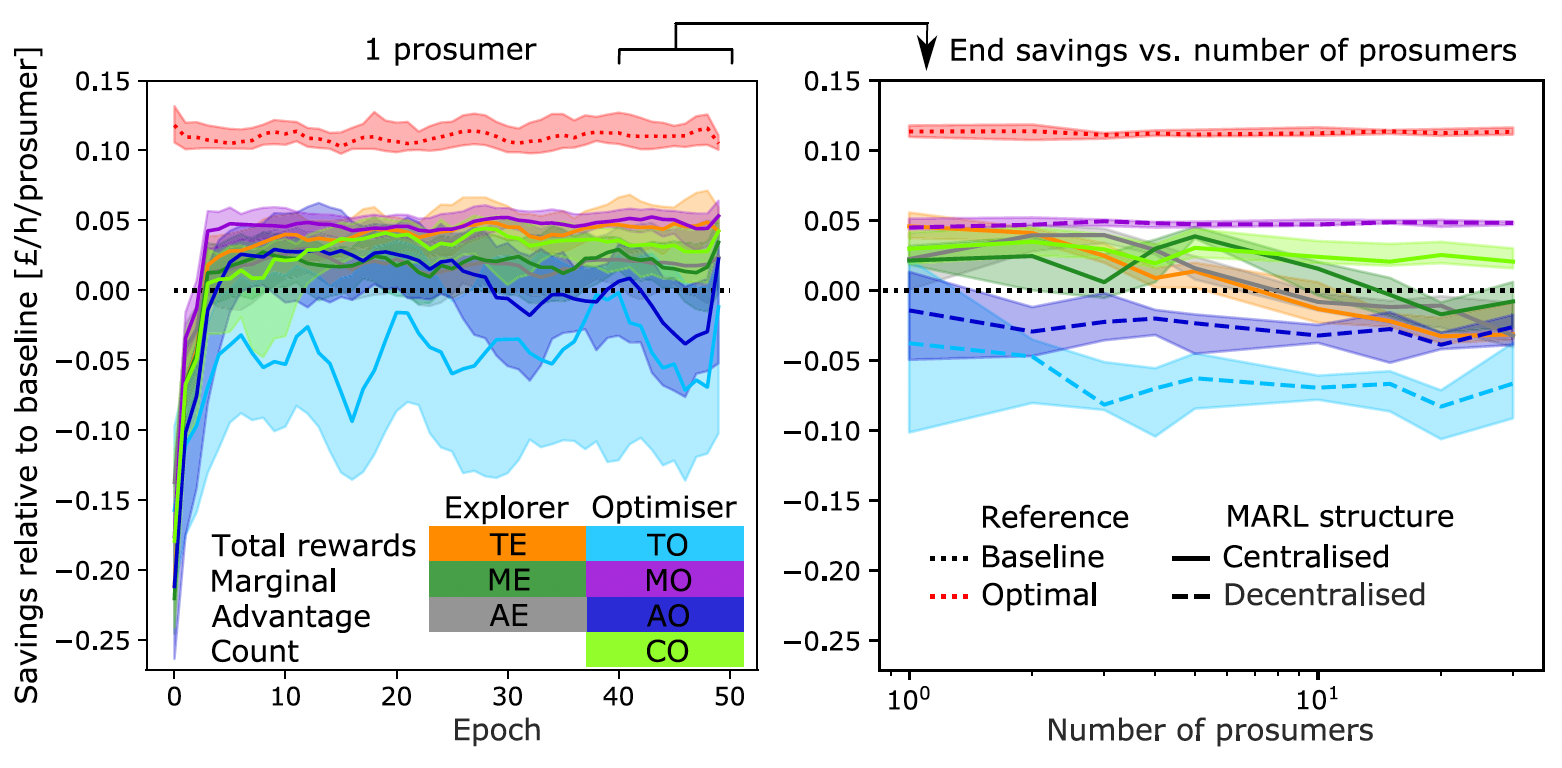
Multi-agent AI for Grid-Edge Flexibility: Coordinating large populations of grid-edge devices requires learning-based approaches that can scale to millions of agents while respecting power flow limits which place hard constraints on their collective operation. Our initial contributions proposed and developed scalable multi-agent reinforcement learning (MARL) (Charbonnier et al., 2022) and deep MARL (Charbonnier et al., 2025) approaches which leverage centralised offline training to develop independent grid-edge device agent policies that can provide decentralised coordination during operation. Building on this work, we then proposed gradient-based multi-agent proximal learning (GradMAP) (Zhou et al., 2026), which uses differentiable power grid modelling to propagate exact network-constraint violations to update policy parameters enabling 1,000+ safe agent policies be trained in minutes.
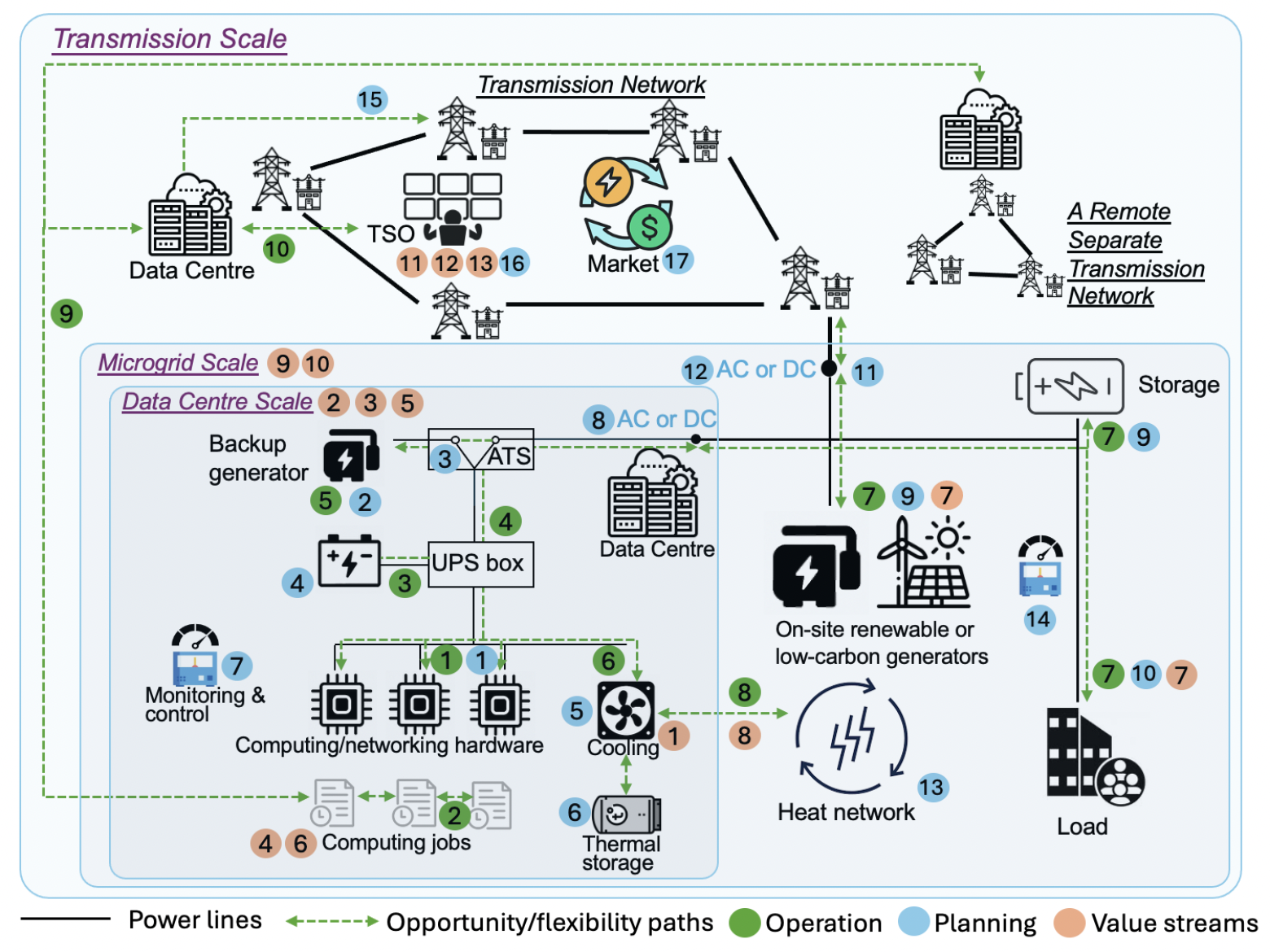
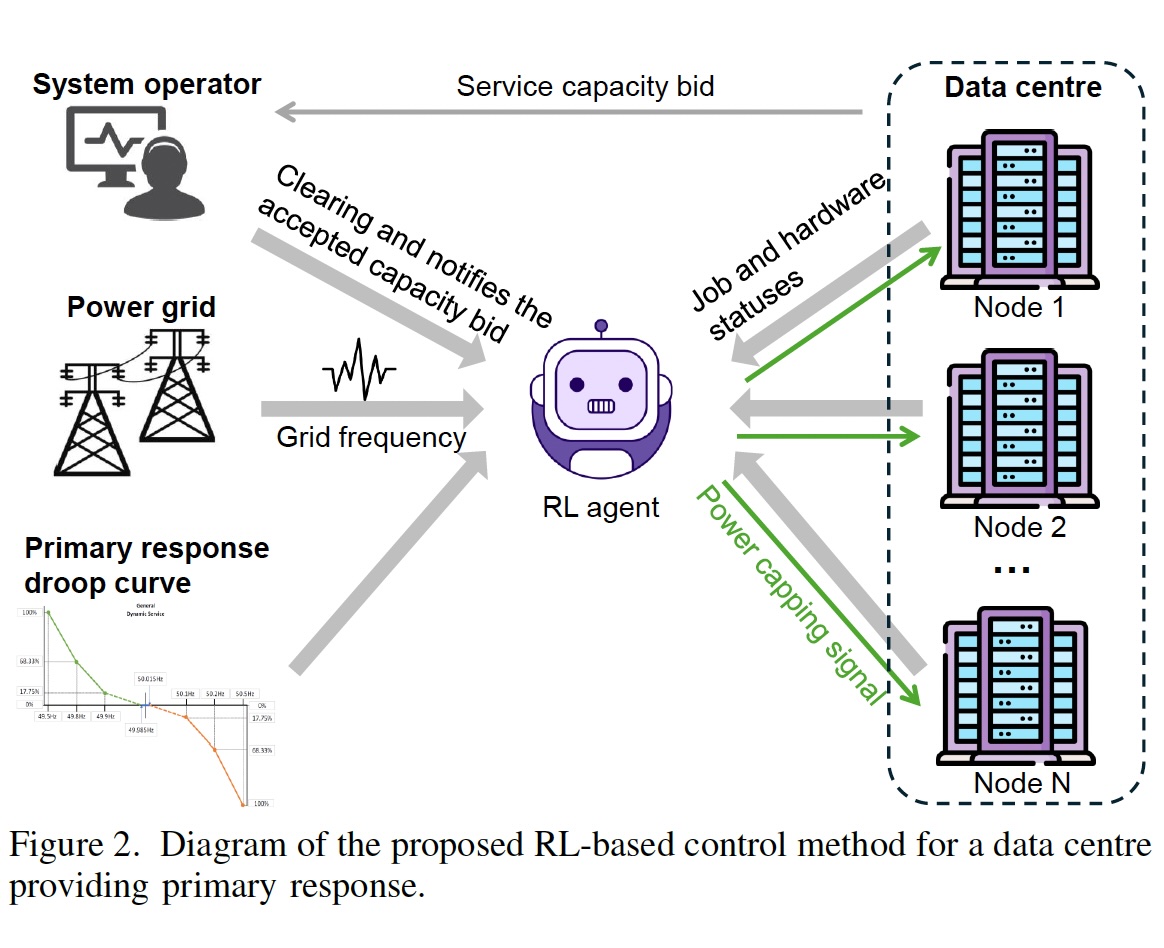
Data Centre Grid Flexibility: AI data centres represent a rapidly growing source of electricity demand, which is challenging decarbonisation efforts. In (Morstyn et al., 2026) we explore the challenges posed by data centres, as well as opportunities for grid flexibility to be obtained from primary and backup generation/storage assets, cooling systems and compute infrastructure. For GPU-rich AI data centres, we have proposed and demonstrated the novel use of GPU power capping to enable AI data centres to provide primary frequency response, and other fast high-value flexibility services (Zhou & Morstyn, 2026).
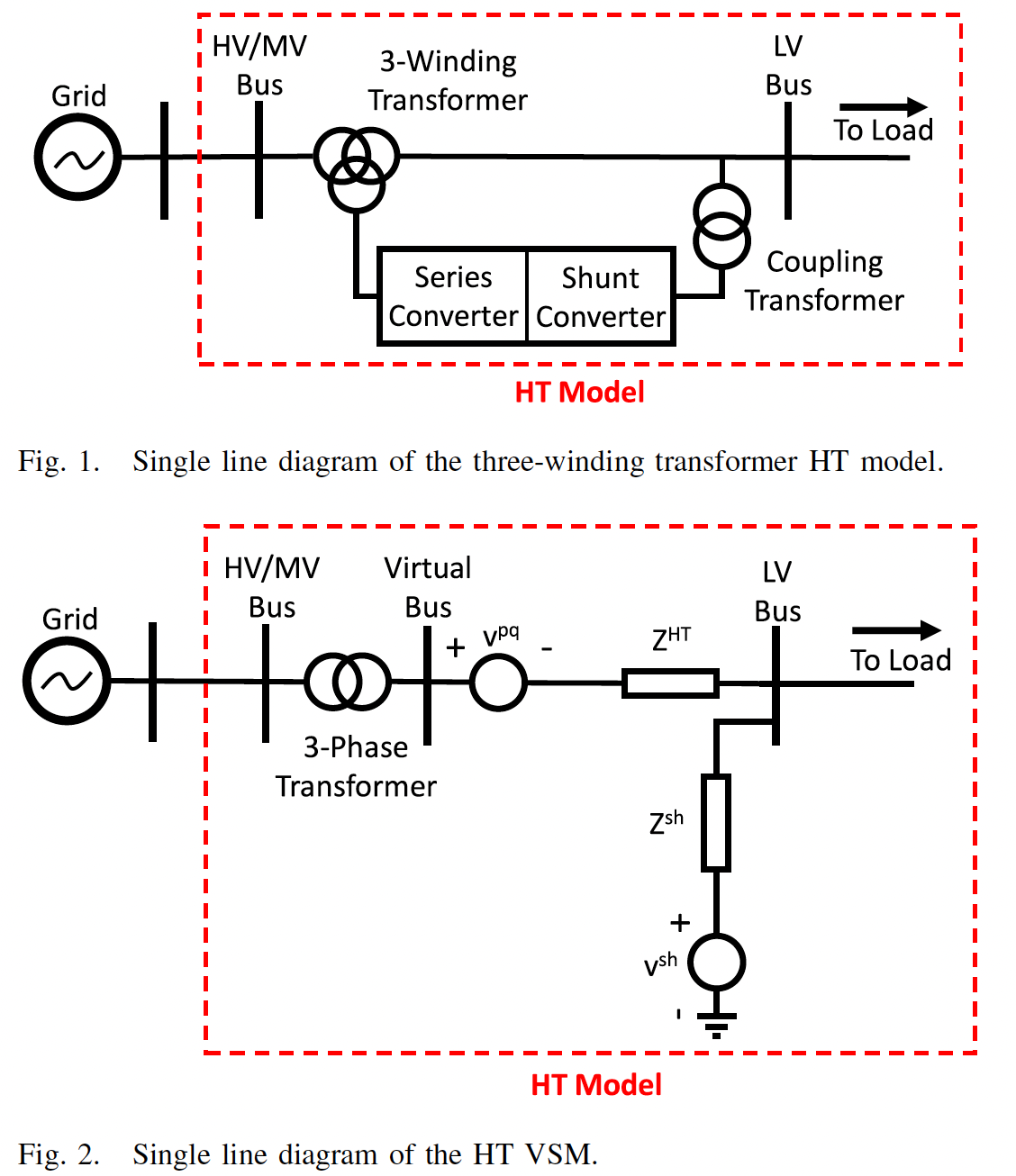
Control of Hybrid Intelligent Transformers (HITs): HITs combine a conventional distribution transformer with fractionally rated power electronics to provide advanced control capabilities associated with fully solid state transformer at substantially lower cost. In collaboration with IONATE, we have developed control strategies enabling the simultaneous delivery of grid services, including voltage regulation, phase balancing, and frequency response (Doff-Sotta et al., 2026), and an optimisation strategy for coordinating multiple HITs in unbalanced distribution networks to manage voltage limits while maximising the export of embedded renewable generation (Hayward et al., 2024).
Battery Storage and Electric Vehicle (EV) Control: Realising the full value of batteries and EVs requires control strategies that respect battery electrochemistry voltage rise under fast charging, efficiency losses at low power, and degradation under cycling. We developed optimisation strategies for EV fast charging stations which account for the nonlinear dependence between state-of-charge (SoC) and charging power limits (Morstyn et al., 2020), and demonstrated how accounting for charger efficiency curves alters optimal charging schedules (Crozier et al., 2019). For battery storage, deep reinforcement learning-based arbitrage outperforms model-based approaches given nonlinear battery degradation and market price uncertainty (Cao et al., 2020).
Control of Microgrid Energy Storage: Microgrids require control strategies that maintain stability and optimise energy use across heterogeneous storage assets without centralised communication. Multi-agent active SoC balancing between distributed storage systems provides a scalable approach for ensuring the full combined power and energy capacities of storage systems are utilised in AC (Morstyn et al., 2014) and DC (Morstyn et al., 2015) microgrids. This approach can be extended with multi-agent sliding-mode control to speedup balancing and eliminate circulating currents (Morstyn et al., 2017). We have also developed model predictive control (MPC) for optimising AC (Morstyn et al., 2017) and DC (Morstyn et al., 2016) microgrids with distributed energy storage systems. Active SoC balancing between storage system clusters can be used to simplify optimisation without compromising performance (Morstyn et al., 2017)
References
2026
- arXiv
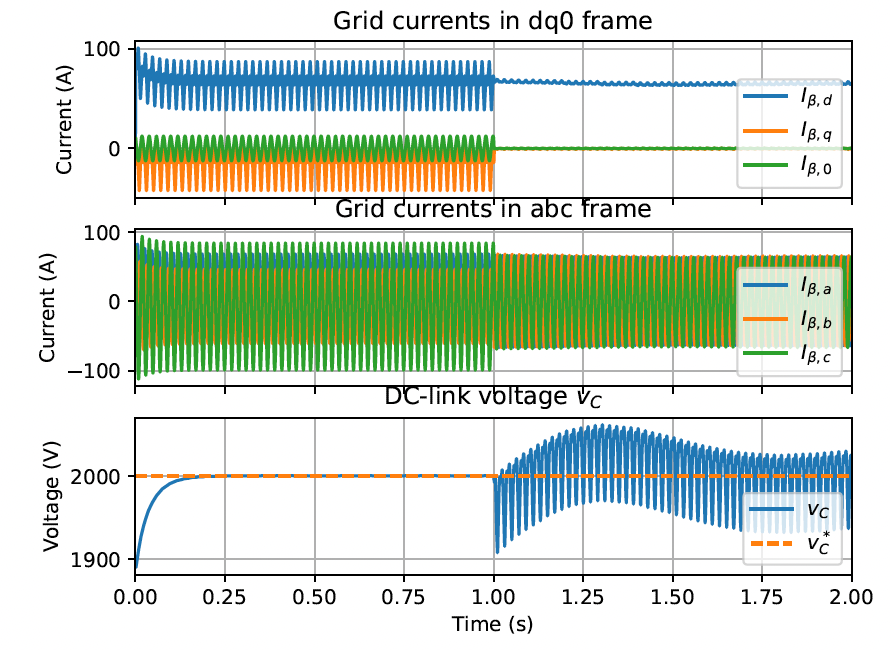 Modeling and Control of Hybrid Distribution Transformers for Simultaneous Grid ServicesarXiv preprint arXiv:2602.00798, 2026